



Most businesses don’t really have a marketing strategy. By that, we mean a deliberate, connected plan that ties every tactic to a business goal and makes it possible to prove what’s working.
That’s not OK. When clients come to us without a strategy, we work with them to build one. We get to know their business growth goals, timeline, target audience, and just about all the context we can find (we love context!) that will help us deliver a completely custom marketing strategy that’s built to help that specific business grow and thrive.
This guide covers almost everything you need to build one for your business.
What is a digital marketing strategy, and why does it matter?
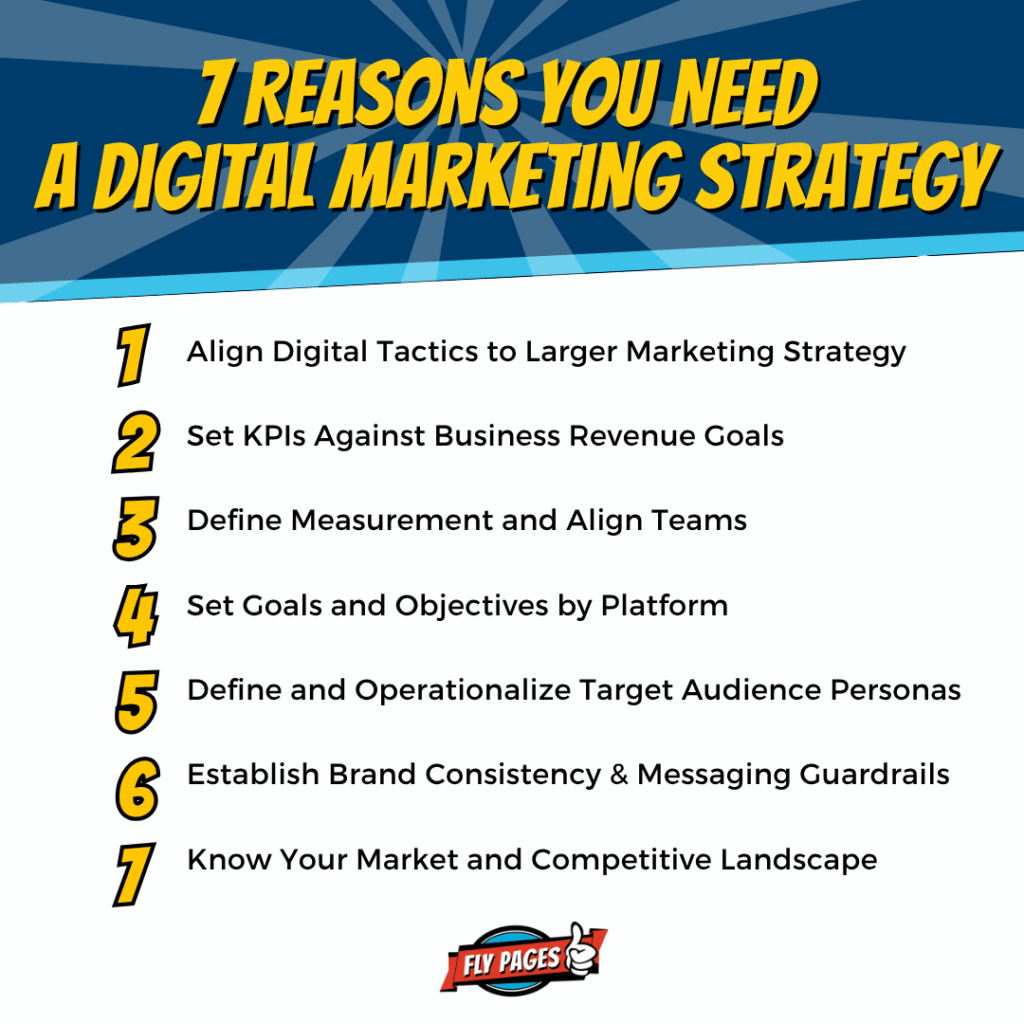 A digital marketing strategy is a deliberate plan that connects your digital marketing activities to your larger marketing strategy, which is built to help you reach your business goals. A strategy defines who you’re trying to reach, what you want them to do, which channels will get you there most efficiently, and how you’ll know it’s working.
Most businesses have tactics. They’re running ads, posting on social media, sending emails, maybe blogging or even paying an agency for “SEO.” But without a strategy connecting those pieces and tying them to revenue goals, each tactic operates in isolation.
“We think it’s working” isn’t an answer we’re willing accept.
A strategy changes the lens through which all marketing activities and results are evaluated. It gives every tactic a purpose, every dollar a benchmark, and every result a context. It’s the difference between marketing that generates activity and marketing that generates revenue.
What a complete marketing strategy actually includes
 A marketing strategy isn’t one document; it’s a connected system of decisions across five areas. Most marketing problems like unclear ROI, inconsistent results, and budget fights trace back to one of these five being underdeveloped or disconnected from the rest.
- Goals and KPIs What are you trying to accomplish, specifically? Not “grow the business,” but SMART goals. A SMART goal is specific, measurable, achievable, realistic, and time-bound, and it’s tied to a business outcome. Before any tactic is deployed, there should be a clear answer to: what does success look like, and how will we know when we’ve achieved it? This is the heaviest lift for many organizations that come to us for strategy, and it accounts for about 30 percent of each of the strategies we create for our clients.
- Audience and Messaging Who are you trying to reach, and what do they need to hear to take action? Audience definition goes beyond demographics. It also includes understanding what drives purchase decisions, what objections exist, and where your audience spends their time online. Messaging is how you translate that understanding into words that move people to action.
- Channel Mix Which platforms and tactics will reach your audience most efficiently at each stage of their decision-making process? The right channel mix depends on your audience, your goals, your budget, and your competitive landscape. But, that only gives you a place to start. You still have to test, learn, measure, and optimize, but at least you’ll know where to find your audience so that data can inform positive action that leads to results.
- Content and Creative What are you going to say, show, and offer across those channels, and how often? Content is the fuel that powers every other part of your strategy. Without a deliberate content plan, even the best channel mix runs dry. And remember: content isn’t just words. It’s on-brand graphics, video, photos, and anything that can be consumed (viewed) by your audience.
- Measurement and Optimization How will you track performance, report on it, and use what you learn to improve? This is the component most businesses bypass, and it’s the one that makes everything else smarter over time.
How to set marketing goals that leadership will actually care about

The most common marketing goal problem isn’t ambition; it’s specificity. Goals like “increase brand awareness” or “get more leads” are starting points, not strategies. To connect marketing to revenue, goals need to be built on the SMART framework: Specific, Measurable, Achievable, Relevant, and Time-Based.
But SMART goals alone aren’t enough. Each goal also needs to trace back to a business outcome. “Generate 40 qualified leads per month through paid search by Q3” is a SMART goal. It becomes a revenue goal when you know your average close rate and customer value so that 40 leads translates to a projected revenue number your CFO can evaluate.
The connection between marketing activity and projected revenue outcome is what separates a marketing strategy from a marketing plan. It’s also what makes it possible to have a rational conversation about budget, when you’re empowered by data to back up your recommendations.
How do goals and strategy work together to produce results?
Really, it’s the same way marketing and sales work together to grow revenue streams.
Our clients are proof that our “pleasantly persistent” push to get sales-side data is essential to proving marketing ROI. We believe that marketing and sales need to work together to truly optimize marketing efforts and get results that impact the business goals.
Here are a few case studies that prove the data-driven approach to continuous learning and optimization really does work.
 Integrated messaging and collaboration between SEO + AI Visibility teams and Paid Ads teams continues to drive record-breaking revenue for this energy company in the Mid-Atlantic. Their annual FY25 marketing ROI was 20:1. In Q1 of the subsequent fiscal year, they broke every previous year’s revenue records.
Read the Case Study
Integrated messaging and collaboration between SEO + AI Visibility teams and Paid Ads teams continues to drive record-breaking revenue for this energy company in the Mid-Atlantic. Their annual FY25 marketing ROI was 20:1. In Q1 of the subsequent fiscal year, they broke every previous year’s revenue records.
Read the Case Study What happens when three powerhouse marketing teams unite with a common goal? This fitness club not only met their annual new membership goal, they beat it by 10 percent. And, they could prove marketing was the secret ingredient because we helped them build the sales partnership to prove it.
Read the Case Study
What happens when three powerhouse marketing teams unite with a common goal? This fitness club not only met their annual new membership goal, they beat it by 10 percent. And, they could prove marketing was the secret ingredient because we helped them build the sales partnership to prove it.
Read the Case Study
 Fly Pages helped to successfully bring eight Mid-Atlantic B2C energy companies under one super brand, then implemented a digital marketing strategy that resulted in huge ROI. Leadership got the receipts, and saw that marketing delivered 107 percent of the growth goal.
Read the Case Study
Fly Pages helped to successfully bring eight Mid-Atlantic B2C energy companies under one super brand, then implemented a digital marketing strategy that resulted in huge ROI. Leadership got the receipts, and saw that marketing delivered 107 percent of the growth goal.
Read the Case StudyHow do I measure marketing performance and prove ROI?
Strategic measurement of marketing performance requires moving beyond channel metrics (impressions, clicks, open rates) and building a measurement framework that connects marketing activity to business outcomes: leads generated, cost per lead, pipeline influenced, revenue attributed.
Measurement isn’t only a reporting function; it’s also a strategic one. The decision about what to measure should be made before campaigns launch, not after. The metrics you track should flow directly from the goals you set, and the reports you produce should answer one question for leadership: is the investment we’re putting into marketing actually delivering a return?
Accurately determining ROI means:
- having the tracking infrastructure in place (GA4, conversion tracking, CRM integration) to make attribution possible,
- getting sales team buy-in and bringing their leadership to the table, and
- producing reporting that leadership can understand without a decoder ring.
Most marketing teams struggle here not because they lack data, but because they have too much of it and no framework for turning it into decisions. A measurement strategy fixes that.
How do I build an integrated marketing strategy?
Integrated marketing means every tactical channel in your strategy is working toward the same goal, speaking with the same voice, and sharing data that can prove the strategy is working to positively impact revenue. This interconnected data-sharing tells your marketing team what’s driving revenue, and what needs adjustment to drive even more results.
Here’s what integration looks like in practice:
- Your paid search campaigns drive traffic to landing pages built in alignment with your SEO and content strategy.
- Your email nurture sequences follow up on ad conversions with messaging consistent with what the ad promised.
- Your social media presence builds the brand awareness that makes your email open rates higher and your ad costs lower.
- Your analytics and reporting connect all of it so you can see the full picture, and not just individual channel metrics.
When tactics are siloed, you get duplication, contradictory messaging, and budget inefficiency. When they’re integrated, each channel amplifies the others and your reporting actually tells you what tactics are producing revenue-generating conversions, and what your customer journey looks like in real life.

Step 1: Audit your current marketing approach and tactical mix
Most mid-market companies that come to Fly Pages don’t need to start over. They need to understand what’s working, what isn’t, and why, and then build a strategy that fixes the gaps and amplifies what’s already generating results.
A marketing audit answers those questions systematically. It covers channel performance, audience alignment, messaging consistency, content quality, tracking accuracy, and budget allocation. The goal isn’t to produce a report, it’s to produce a clear set of priorities that outline what to stop, what to start, and what to double down on.
Done well, an audit typically surfaces two or three high-leverage opportunities that weren’t visible before. These are places where a relatively small change in strategy or budget allocation could produce a disproportionate improvement in results.

Step 2: Choose the right marketing partner
For most companies with marketing departments that are stretched thin already, the question isn’t whether to work with an outside marketing partner; it’s how to find one that will actually function as a partner rather than a vendor. The difference matters more than most businesses realize until they’ve experienced both.
A vendor executes tasks, where a partner understands your business, builds a strategy tied to your goals, holds itself accountable to your outcomes, and communicates in a way that makes your leadership team smarter about marketing, and not more dependent on the agency to interpret it.
Red flags worth taking seriously: partners who can’t clearly explain what they’re doing and why, reporting that shows activity without connecting it to results, resistance to transferring account ownership, and strategies that seem to require constant agency involvement to sustain.
The right partner makes you less dependent over time, cares about your goals, overcommunicates, and wants you to succeed. When you win, we win.

Step 3: Get clarity before you get into building a strategy
Every Fly Pages engagement starts in the same place: clarity. Before we recommend a single tactic, we invest in understanding your business, your goals, your audience, your competitive landscape, and the gaps between where you are and where you’re trying to go.
From there, we build a strategy across the five components described in this guide (goals and KPIs, audience and messaging, channel mix, content, and measurement) and deploy our Proven Process to implement it, learn from it, optimize it, and report on it in a way your leadership team can use.
We don’t hand you a strategy document and wish you luck. We partner with your team through implementation and beyond functioning as the fractional marketing team that brings both the strategic thinking and the tactical expertise to make it work.
The result is marketing that can answer the question leadership always asks: what is this doing for our business?
